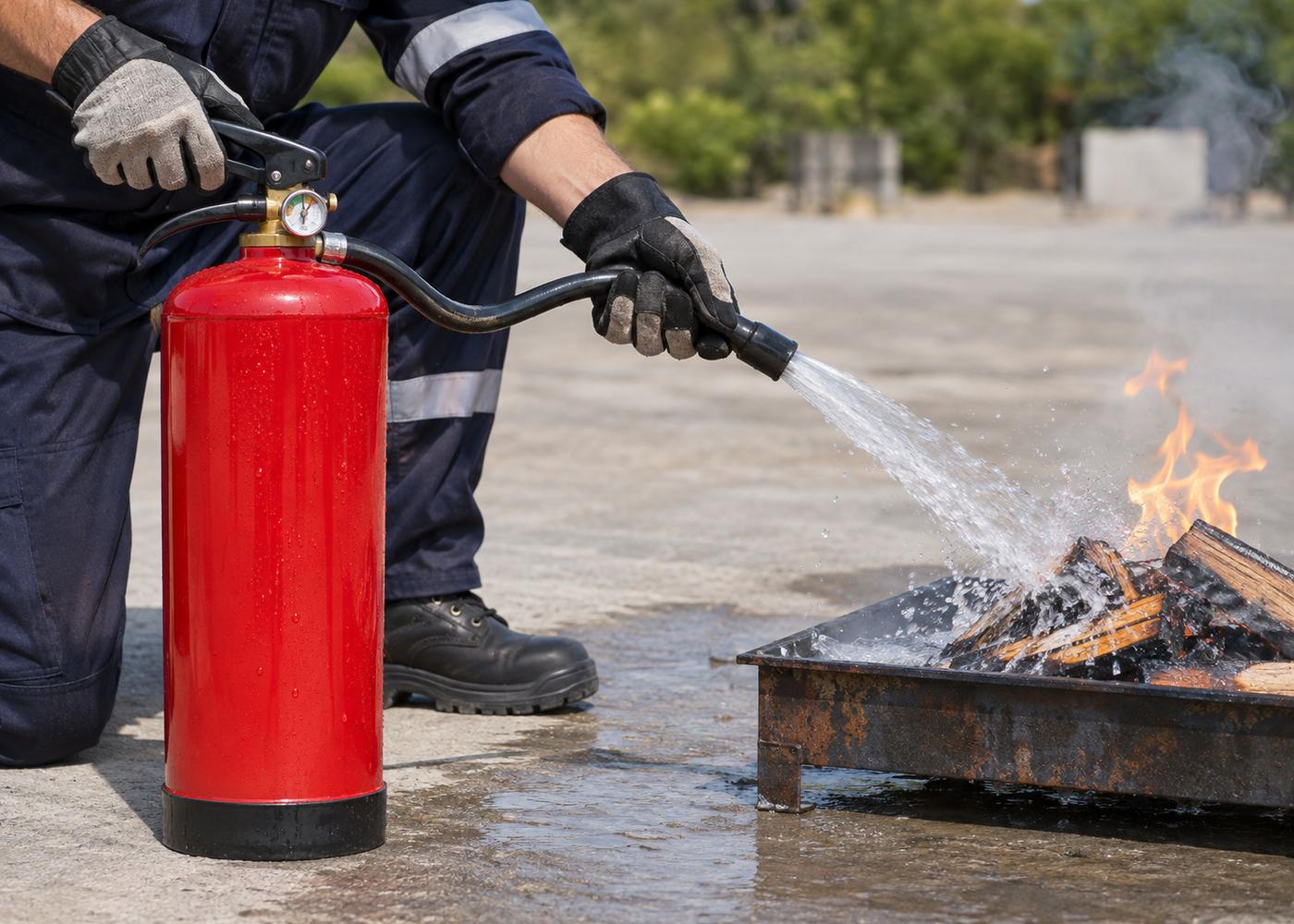
Water fights fire in two stages. It soaks up heat as it warms, then far more as it turns into steam. That is how water fire extinguishers work: they cool burning material until it can no longer burn, while gas pressure stored in the cylinder pushes the water out in a controlled stream. The same idea explains why water works well on wood and paper but can be dangerous on oil, flammable liquids and live electrics.
A fire needs heat, fuel and oxygen, often called the fire triangle, and taking away any one of them stops it. Ordinary water mainly goes after the heat. It lands on the burning surface, takes in heat and boils off as steam, which cools the fuel until it can no longer feed the flames.
Picture a stack of cardboard boxes burning in a storeroom. Water wets and cools the outer layers and can soak into the folds, which is why guidance based on BS 5306-8:2023 describes water as effective on Class A fires, including deep-seated ones.
Most portable water units are stored-pressure extinguishers. The water and a propellant gas share one sealed cylinder, and the valve on top stays shut until you squeeze the lever. A dip tube, also called a siphon tube, runs from the valve to the bottom of the cylinder, and the nozzle or hose shapes the stream.
When you squeeze the lever, the gas pressing down on the water drives it up the dip tube and out through the nozzle. It works like blowing into a sealed bottle, which forces the liquid up and out through a straw.
A cartridge-operated extinguisher works differently, because it keeps its gas in a separate cartridge. Gas type, pressure and capacity also vary between models. The Amerex Model 240, for example, holds about 9.5 litres of water, is charged with air or nitrogen to about 6.9 bar and empties in about 55 seconds. Charging any pressure vessel is a job for trained technicians.
Ordinary water extinguishers are made for Class A materials: wood, paper, cloth, rubber and certain plastics. The OSHA guide to portable fire extinguishers explains the two biggest risks outside that group. Water can spread a burning flammable liquid, and it can carry electricity back to the person holding the extinguisher.
Now picture an appliance that is still plugged in, smoking on a kitchen counter. The melting plastic is a Class A material, but the appliance is live, so a stream of ordinary water could carry the current to you. Cut the power only if you can do it safely, and use an extinguisher rated for electrical risks.
| Burning material | Ordinary water? | Reason |
|---|---|---|
| Wood, paper, cardboard, cloth | Yes | Water cools and soaks the fuel |
| Petrol, solvents and other flammable liquids | No | Water can spread the burning liquid |
| Live electrical equipment | No | Water can carry electricity to you |
| Cooking oil and fat | No | Water flashes into steam and can cause serious burns |
| Burning metals and substances that react with water | No | Ruled out in manufacturer instructions |
Cooking oil fires need a wet chemical agent, which reacts with the surface of the oil to form a layer that keeps air out. Many commercial kitchens also install kitchen hood fire suppression systems.
Not quite. Mist models use a special nozzle that breaks the water into fine droplets, which one manufacturer says improves cooling and scatters less burning material. Some, such as Amerex's B270 and B272, are UL Listed for Class A fires and for what the US system calls Class C electrical hazards, and they must be filled with deionised water.
This is where people often go wrong. Filling an ordinary water extinguisher with distilled water does not make it safe on electrics, because pure water picks up dirt and carbon dioxide during use and can start to conduct electricity. Electrical safety comes from testing the whole extinguisher as one unit. So trust only the rating on that model's label and follow its conditions, including any minimum distance from the equipment. Never assume a mist unit is safe on cooking oil.
Some water extinguishers also contain additives, such as anti-rust chemicals, antifreeze or wetting agents. Foam is water mixed with foam concentrate, so it cools Class A fires and also forms a layer that keeps air away from the fuel. Our guide to types of fire extinguishers in the UAE compares these agents. Never add anything to an extinguisher yourself.
A needle in the green zone means the pressure is high enough for the extinguisher to work. It does not prove the cylinder is full, so manufacturers check that separately by weighing or lifting the unit. Amerex's inspection list for the Model 240 also covers:
- clear access to the extinguisher
- readable instructions facing outward
- an unbroken tamper seal
- no damage, rust or leaks
- a nozzle that is not blocked
That manufacturer asks for a monthly inspection and maintenance at least once a year. These are the manufacturer's instructions, not the legal intervals that apply in the UAE, so confirm your obligations with Dubai Civil Defence or your approved maintenance contractor.
When you read a label, check the fire classes and the rating rather than the colour. UAE manufacturer FIREX lists its water extinguishers as red, so the silver cylinders described in American guides tell you nothing here. American labels also use Class C for electrical fires and Class K for cooking oil, so treat those letters as US terms.
If a fire breaks out, press the nearest manual fire alarm call point, call Civil Defence on 997 and leave by the nearest safe exit without using the lifts. Only use an extinguisher if other people have been warned, the fire is small and contained, the smoke is not dangerous and your way out is clear. Then pull the pin, aim low at the base of the fire, squeeze the lever slowly and sweep from side to side. Our guide on how to use a fire extinguisher in Dubai covers this in more detail.
Yes, but not by you. Manufacturers say an extinguisher should be professionally serviced and recharged after any use, even a short burst. Because it is a pressure vessel, that work needs trained people with the right equipment. Our article on fire extinguisher refilling cost in Dubai explains what quotes usually include.
No. Water can ruin paper, cardboard and fabric dyes, make some metals rust and short-circuit live equipment, so a room can look clean and still have hidden damage.
Not necessarily. Cooling only works where the water reaches, so embers deep inside packed material can keep glowing after the flames have gone, and smoke may still be in the air. Leave the room and let Civil Defence confirm that the fire is fully out.
Website and SEO By Poland Web Designer
Guard Master © Copyrights 2020 - 2026. All rights reserved.
