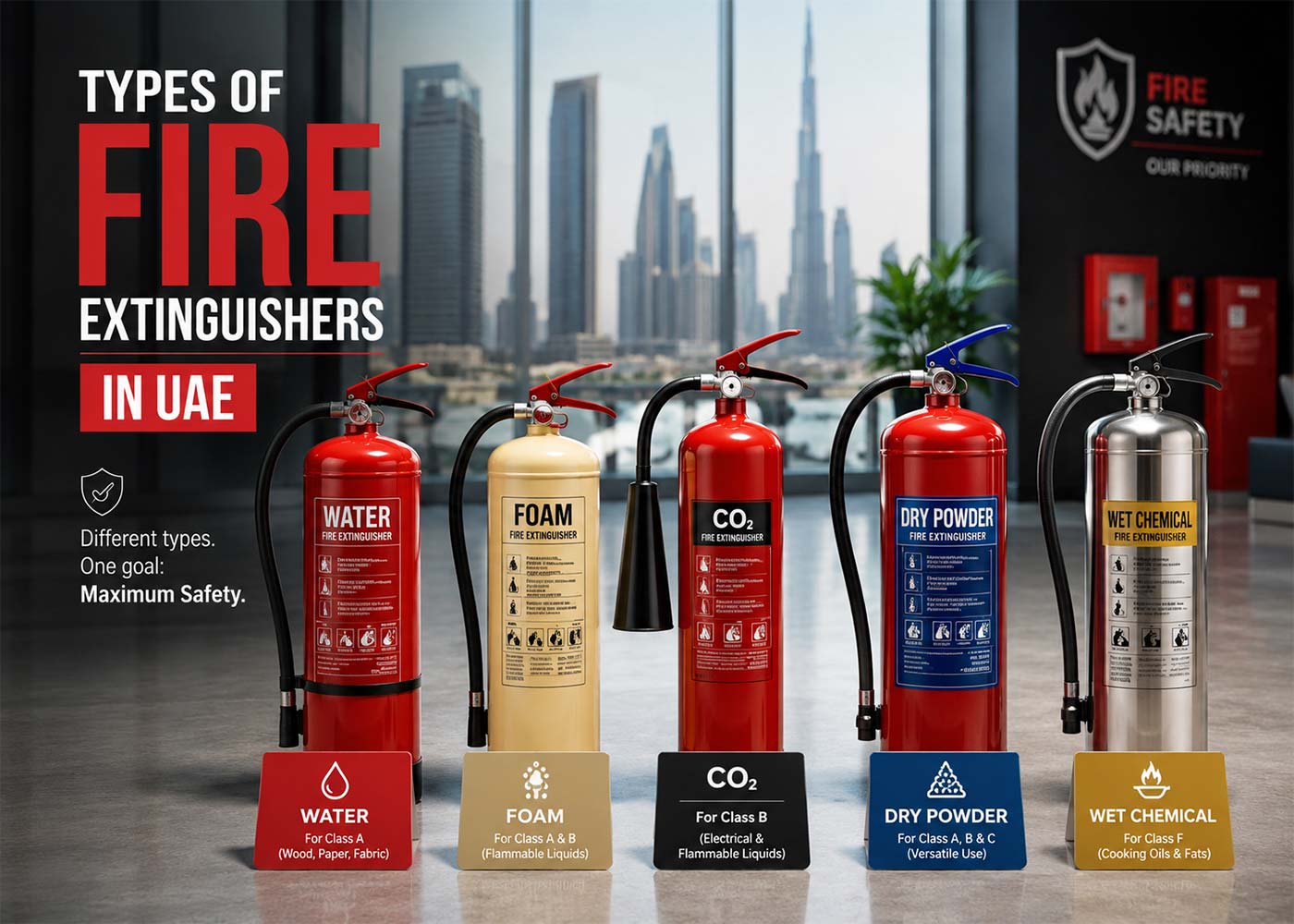
Not every fire extinguisher does the same job. Some are
built for wood and paper, others for oil, and others for live electrical
equipment. Using the wrong one can make a fire worse instead of putting it out.
In the UAE, buildings are required to have the correct extinguisher type for
the risks present in that space, so it helps to know what each one does before
you ever need to reach for it.
Before looking at extinguisher types, it helps to understand
fire classes, since these classes decide which extinguisher works. Class A
covers ordinary materials like wood, paper, and fabric. Class B involves
flammable liquids such as petrol, oil, and paint. Class C deals with flammable
gases. Electrical fires involve live wiring and equipment. Class K, sometimes
called Class F, covers cooking oils and fats. Each type of extinguisher is
matched to one or more of these classes, and checking the label before use is a
habit worth building.
Dry powder extinguishers are the most common type found
across the UAE. They carry an ABC rating, meaning they work on Class A, B, and
C fires. This makes them a practical choice for homes, offices, and mixed use
buildings where more than one type of fire risk exists.
The powder works by breaking the chemical reaction that
keeps a fire burning, and it also smothers the flames. This gives it a broad
range of use, which is why so many buildings rely on a single ABC unit rather
than several separate types.
There are downsides though. The powder creates a cloud that
reduces visibility in an enclosed room, and it leaves a residue that is hard to
clean. If you have server rooms or areas full of sensitive electronics, powder
extinguishers are usually not the first choice, since the residue can damage
that equipment.
CO2 extinguishers are built for electrical fires and are a
common sight near server rooms, electrical panels, and offices packed with
computers. They work by displacing oxygen around the fire, which cuts off what
the flames need to keep burning.
One big advantage is that CO2 leaves no residue behind. Once
the fire is out, there is nothing to clean up, which is exactly why data centers
and control rooms favor this type. The tradeoff is that CO2 extinguishers have
a shorter range and can lose effectiveness outdoors, since wind scatters the
gas before it can smother the fire properly.
Foam extinguishers handle Class A and Class B fires, so they
cover ordinary combustibles and flammable liquids. The foam spreads across the
surface of the fire and forms a barrier that blocks oxygen from reaching the
fuel. This barrier also helps stop the fire from reigniting after the flames
appear to be out.
Foam extinguishers work well in areas where flammable
liquids are stored or handled, such as workshops and garages. They are not
suitable for electrical fires or gas fires, so check the label carefully before
grabbing one in an emergency.
Water extinguishers are simple and only rated for Class A
fires. They cool the burning material by absorbing heat, which lowers the
temperature enough to stop the fire from spreading.
Water should never be used on an electrical fire, since
water conducts electricity and can cause a serious shock. It should also never
be used on burning oil or grease, because water causes hot oil to splash and
spread the fire rather than putting it out. In the UAE, water extinguishers
with an added agent are sometimes used, and these can be safer around
electrical equipment, but a standard water extinguisher should stay far away
from anything electrical.
Wet chemical extinguishers are designed specifically for
Class K fires, which involve cooking oils and fats. Commercial kitchens across
the UAE are required to have these on hand, since a standard extinguisher
cannot safely handle a deep fryer fire.
The extinguisher sprays a fine mist that cools the burning
oil and forms a soapy layer across the surface. That layer seals off oxygen and
prevents the fire from reigniting once it has been knocked down. Wet chemical
units are usually supplied with a long application lance, which lets the user
stand back from the heat and flames while spraying.
Selecting the right extinguisher comes down to identifying
the fire risks in a particular area. A kitchen needs a wet chemical unit for
oil and fat fires. An office or server room needs a CO2 unit to protect
equipment while dealing with electrical risk. A warehouse or workshop storing
flammable liquids may need foam or dry powder units instead.
Many buildings in the UAE end up needing a mix of
extinguisher types rather than relying on just one. A restaurant, for example,
might need wet chemical extinguishers in the kitchen and ABC powder units in
the dining area and storage rooms. Getting this mix right is part of what Dubai
Civil Defence checks during building inspections, so matching extinguisher type
to risk is not just good practice, it is often a legal requirement.
The heat in the UAE plays a role in extinguisher performance
too. High temperatures can affect pressure and speed up wear on components, so
many suppliers recommend slightly larger units than the minimum standard size.
A small two kilogram unit might suit a residential space, while commercial
buildings often need units in the three to six kilogram range, and industrial
sites may require six to nine kilograms or more.
Checking the pressure gauge regularly is worth the effort,
especially given the local climate. A green zone on the gauge means the
extinguisher is ready to go. A gauge sitting in the red zone means the unit
needs servicing before it can be trusted in an emergency.
Owning the correct type of extinguisher is only half the
job. Extinguishers need monthly visual checks and a full professional
inspection at least once a year, carried out by a Civil Defence approved
company. Anyone in the household or workplace should also know where each
extinguisher is kept and understand which one to grab based on the type of fire
in front of them.
Fires do not wait for someone to figure out the right
response. Knowing the types of fire extinguishers available in the UAE, and
matching them to the right risk ahead of time, gives you a real chance of
stopping a small fire before it becomes something much worse.
Website and SEO By Poland Web Designer
Guard Master © Copyrights 2020 - 2026. All rights reserved.
