A fire extinguisher only helps if you know how to use it
before the moment you actually need it. Dubai has strict fire safety rules for
every home, office, and building, and part of staying safe is understanding the
equipment sitting in your kitchen or hallway right now. This guide walks you
through the basics, from the types of extinguishers you will find here to the
exact steps for putting out a small fire.
Fire extinguishers are required by law in every residential,
commercial, and industrial building in Dubai. Each unit must have at least one
working extinguisher that meets Dubai Civil Defence standards. This is not just
a suggestion. Landlords and building owners carry legal responsibility for
keeping extinguishers, alarms, and emergency exits in working order, and
inspectors check this regularly.
There is also a real financial reason to take this
seriously. Home insurance policies often require you to maintain your fire
safety equipment. If a fire breaks out and an investigation finds your
extinguisher was expired or missing, your claim could be reduced or denied. So
knowing how to use your extinguisher protects more than just your walls and
furniture.
Not every extinguisher works on every fire, and using the
wrong one can make things worse. In Dubai, you will typically come across two
main types in homes and offices.
ABC dry powder extinguishers handle most general fires,
including wood, paper, fabric, and some flammable liquids. These are the most common
type found in villas and apartments.
CO2 extinguishers are designed for electrical fires. You
will usually find these near electrical panels, server rooms, and areas with
sensitive equipment. Never use a water extinguisher on an electrical fire or a fire
involving flammable liquids. Water conducts electricity and can cause a shock,
and on liquid fires it can actually spread the flames instead of putting them
out.
Kitchens in Dubai homes are also required to have a fire
blanket. For a pan fire, smother it with the blanket or a damp towel rather
than reaching for water. Oil fires and water do not mix well, and pouring water
on a grease fire can cause it to flare up violently.
Before any emergency happens, take a minute to look at your
extinguisher. Every unit has a pressure gauge on the front, usually with a
needle pointing into a green, yellow, or red zone. Green means the extinguisher
is ready to use. If the needle sits in the red, the extinguisher needs to be
replaced or serviced.
Given the heat in the UAE, extinguishers here wear out
faster than in cooler climates. Because of this, it is worth checking the gauge
every month rather than waiting for an annual inspection. Extinguishers also
need professional servicing by a Civil Defence approved company, so keep track
of that service date on the tag attached to the unit.
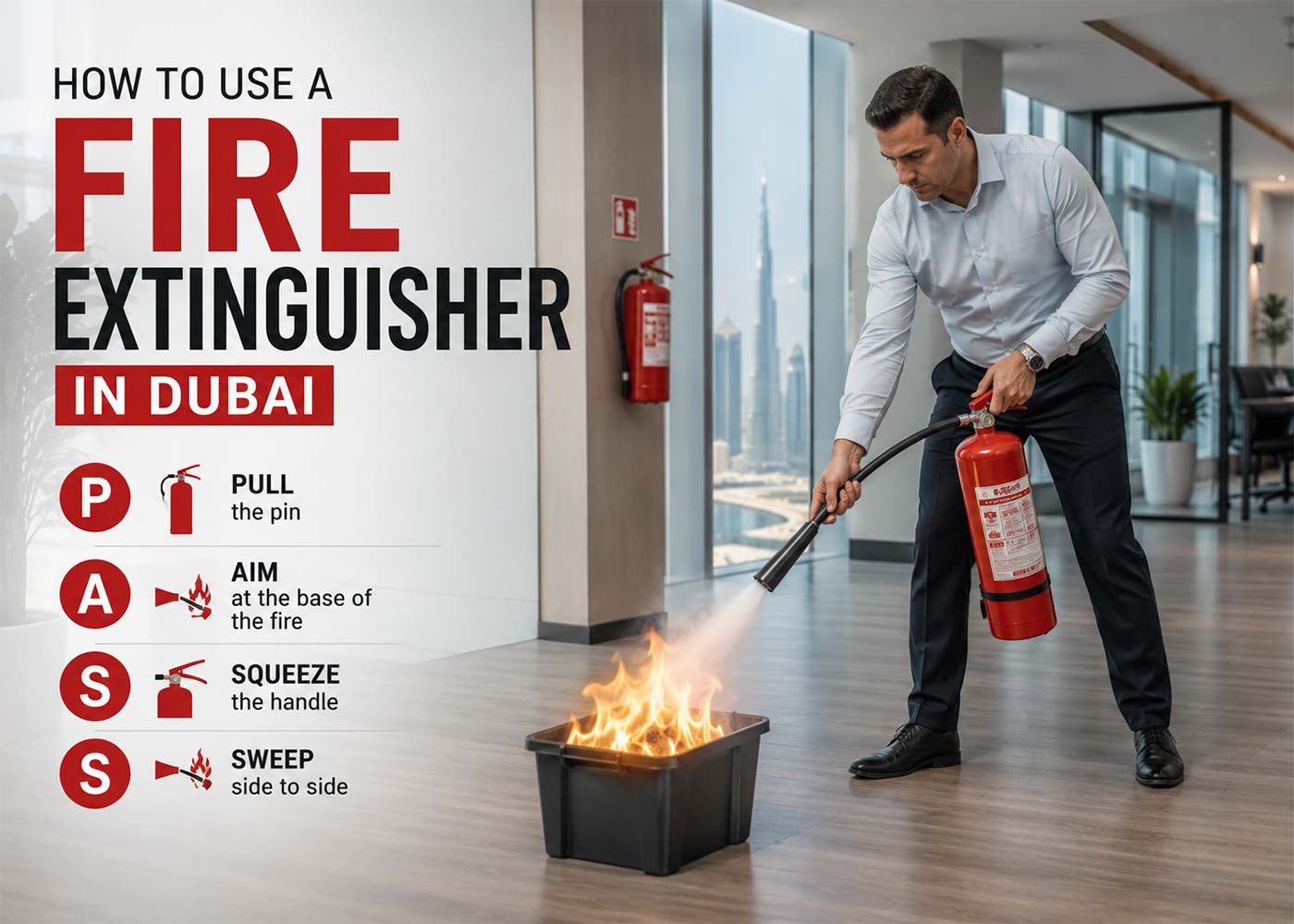
Once you have confirmed the extinguisher works, using it
comes down to four simple steps, remembered by the word PASS.
Pull the pin at the top of the extinguisher. This breaks the
seal and allows the extinguisher to be discharged. Some models have a small
plastic tie that needs to be removed first.
Aim the nozzle or hose at the base of the fire, not at the
flames themselves. The base is where the fuel is burning, and aiming there
actually puts the fire out rather than just scattering the flames.
Squeeze the handle slowly and evenly. This releases the
extinguishing agent. Squeezing too hard or too fast can empty the canister before
the fire is out.
Sweep the nozzle from side to side, moving across the base
of the fire until it is fully out. Keep watching the area after the flames
disappear, since small fires can reignite if any embers remain.
A fire extinguisher is meant for small, contained fires
only. If a fire is larger than a wastepaper basket, or if it is spreading
quickly, do not try to fight it. Leave the area immediately and call 997, the
emergency number that connects you to Dubai Civil Defence.
Even with a small fire, always keep an exit behind you.
Never let the fire get between you and the door. If the room fills with smoke,
or if you have any doubt about your ability to control the fire, get out and
let trained responders handle it.
After leaving a building, go to your designated meeting
point and make sure everyone is accounted for. Do not go back inside for any
reason, including to grab belongings.
Extinguishers must be kept in an easily accessible spot at
all times. Do not block them with furniture, boxes, or anything else, since
this is both a safety risk and a violation that can result in fines. Under UAE
law, tampering with or removing a fire extinguisher can carry serious
penalties, including jail time in extreme cases, so treat these devices as
fixed safety equipment rather than something to move around.
If you live in a villa, keep in mind that requirements
differ slightly from apartments. Villas generally need basic detection and
portable extinguishers, while high rise buildings above 23 meters require
additional systems like sprinklers and fire pumps. Either way, every household
should know where its extinguisher is located and how to reach it in the dark,
since fires often happen alongside power outages or smoke that limits
visibility.
Fire safety training is also recommended for anyone managing
a household staff or a small office in Dubai. A short hands on session, even
once a year, builds the muscle memory needed to act quickly rather than freeze
during an actual emergency.
Knowing how to use a fire extinguisher takes just a few
minutes to learn, but that knowledge can prevent a small kitchen fire from
turning into a major loss. Take the time now to locate your extinguisher, check
its gauge, and walk through the PASS method in your head. It is one of the
simplest ways to protect your home and family in Dubai.
Website and SEO By Poland Web Designer
Guard Master © Copyrights 2020 - 2026. All rights reserved.
