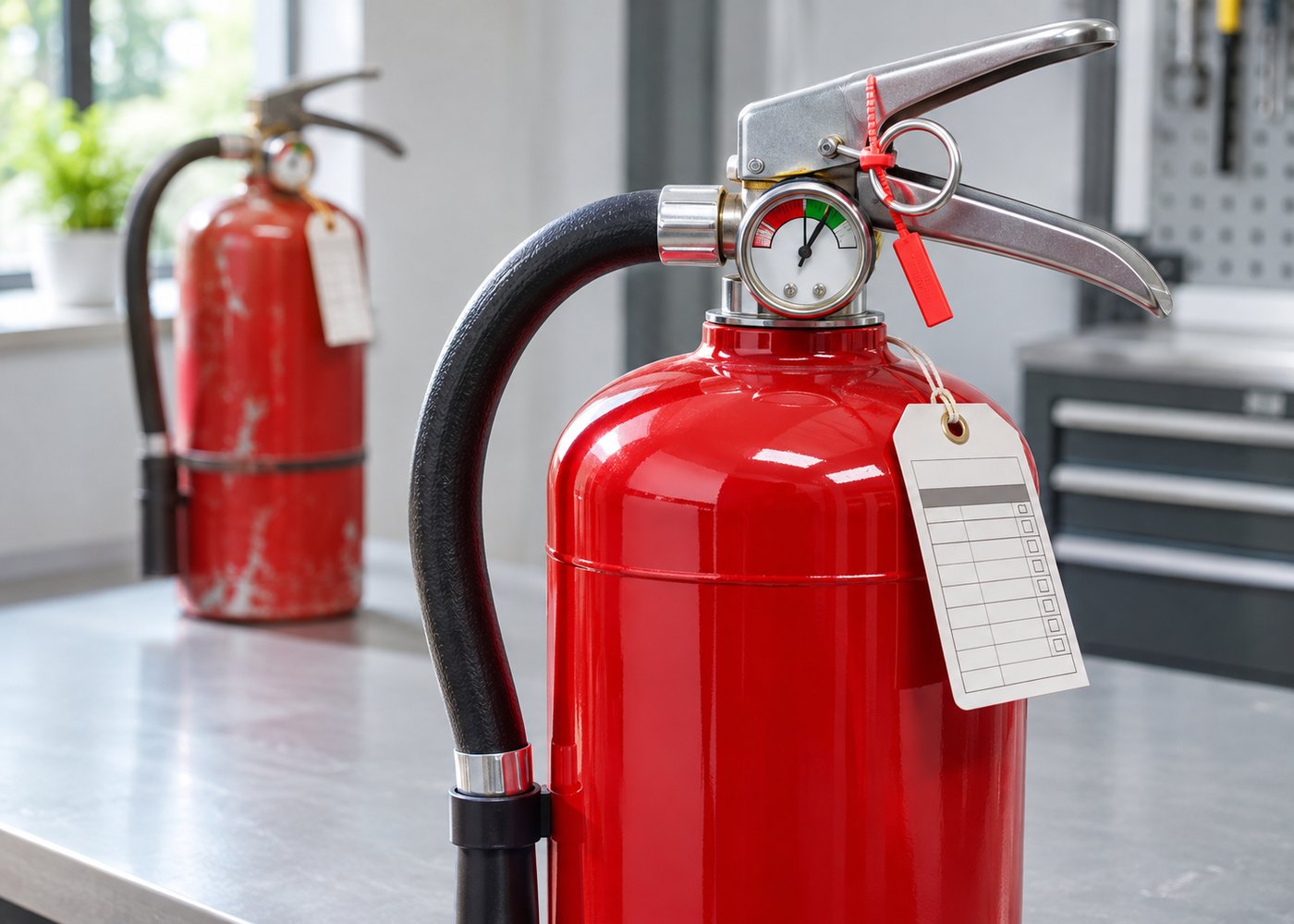
You may have found an extinguisher in a villa you just moved into, or you manage a building where the same units have hung in the corridors for years. So, how long do fire extinguishers last? There is no universal replacement age. Some disposable extinguishers have a maximum life of 12 years set by the manufacturer, while rechargeable models follow their own maintenance, testing and retirement rules. That means the real answer starts with knowing exactly which model you have.
A disposable extinguisher is made to be used once and then replaced. Kidde's manual for its disposable dry-chemical models gives a maximum shelf life of 12 years, counted from the manufacture year stamped on the bottom of the cylinder. It must be replaced right after any use and never recharged. Amerex sets the same 12-year limit for its non-rechargeable Halotron BrX extinguishers, counted from the manufacture date on the nameplate.
A rechargeable extinguisher can be refilled and serviced, and its cylinder is pressure tested at set intervals, but it does not last forever. It stays in service only while it meets the manufacturer's requirements, passes its inspections and tests, and remains in sound condition.
One extinguisher can carry several dates, and each means something different.
The manufacture date tells you the unit's age. Depending on the model, it may be stamped on the cylinder bottom, printed on the nameplate or, on Amerex carbon dioxide cylinders, marked on the dome.
The service date punched on a tag shows when the unit was last inspected or maintained. It is not an expiry date.
The hydrostatic test date shows when the cylinder was last pressure tested. As OSHA's guide to extinguisher hydrostatic testing explains, this test fills the parts with liquid under pressure to find leaks and structural flaws.
The warranty is the maker's promise, and it varies by model. Kidde's US warranty page lists six years for its FA110G and 12 years for its MAR110. Neither figure tells you when to replace the unit.
Think of a service sticker like a stamp in a car's service book. It proves the car was looked after, but it does not make an old car new. In the same way, servicing or recharging an extinguisher does not reset the manufacture date or extend a maximum life the maker has set.
The examples below come from US manufacturer instructions based on US standards such as NFPA 10. They are not UAE law and only show how much schedules can differ.
| Example model | Type | What the maker specifies |
|---|---|---|
| Kidde disposable dry chemical (manual 21028186G) | Disposable | Maximum shelf life of 12 years; replace after any use |
| Amerex Halotron BrX | Disposable | Leave service 12 years after manufacture; replace after any use |
| Amerex stored-pressure dry chemical (manual 05602) | Rechargeable | Internal maintenance every 6 years; hydrostatic test every 12 years |
| Amerex carbon dioxide (manual 05603) | Rechargeable | Weigh against the nameplate; hydrostatic test every 5 years |
| Amerex water, water mist and wet chemical | Rechargeable | Hydrostatic test every 5 years |
The 12 years in the Amerex dry-chemical row is a testing interval, not an order to discard the cylinder. Under that manual, internal maintenance done during a recharge or hydrostatic test also restarts the six-year maintenance interval. Even shell material changes the schedule. The US OSHA table gives a 12-year test interval for dry-chemical units with mild steel, brazed brass or aluminium shells, but five years for stainless steel shells. Under US OSHA rules, a cylinder that fails the test, or cannot be tested, must be removed from service.
A needle in the green means the pressure is in the operating range. It does not prove that the cylinder, agent, hose, nozzle and valve are all sound. OSHA states that a visual inspection alone cannot confirm an extinguisher is safe or will work. So an old unit with a green gauge still needs its history checked and a professional look.
A missing gauge is not automatically a bad sign either. Amerex carbon dioxide extinguishers, for example, are checked by weighing them against the allowable weight on the nameplate.
Owners can do the monthly check Amerex recommends, looking for damage, a blocked outlet, low charge, a broken tamper seal and unreadable instructions. Kidde adds leaks, wear and corrosion. The yearly maintenance is a fuller job for trained people with proper equipment, because an extinguisher is a pressure vessel. Never test one with a quick spray, since Kidde warns this loses pressure and encourages leaks.
Even a short squeeze counts as use. Rechargeable models should be recharged straight away, and disposable models replaced. Spray time is short and varies by model: SFFECO lists 9 to 11 seconds for its 5 kg CD 5-G carbon dioxide model and 65 seconds for its 6 litre SKF 6 wet-chemical model. Our guide to fire extinguisher refilling cost in Dubai explains what a recharge quote usually covers.
Location matters too. Kidde requires units to sit within the temperature limits printed on the nameplate, and these differ by product. SFFECO, for instance, lists operating limits of 0°C to 60°C for its SKF 6 and SKF 10 wet-chemical models, so check the label before mounting a unit somewhere hot.
We found no single UAE-wide replacement age, and rules change, so confirm current requirements with the relevant Civil Defence authority. Local documents show how requirements can differ. DMCC's HSE Guidelines from October 2018 say extinguishers must be inspected regularly, serviced once a year, installed by UAE Civil Defence approved, licensed contractors and taken out of use when obsolete. The JLT Retail Tenant Handbook R4 asks tenants to have extinguishers inspected and certified by a DCD-approved vendor every six months, with tags attached and certificates kept.
These documents have different dates and scopes, so check what your landlord, free zone or community asks for. A clear maintenance contract for fire safety equipment keeps those dates in one place.
Read the nameplate for the make, model and type. Our overview of types of fire extinguishers in the UAE can help you identify it. Then find the manufacture date and any service or hydrostatic test records. A disposable unit that has been used, shows damage or corrosion, or has reached the maker's limit should be replaced.
For anything unclear, ask a Dubai Civil Defence approved contractor to assess the unit against the manufacturer's instructions and local rules. If you run a workplace, plan cover while units are away for servicing, because US OSHA rules require equivalent protection during that time.
When a unit is retired, do not put it in a household bin, drill it, burn it or vent it. Ask your servicing contractor or local waste authority how to dispose of it safely.
Website and SEO By Poland Web Designer
Guard Master © Copyrights 2020 - 2026. All rights reserved.
