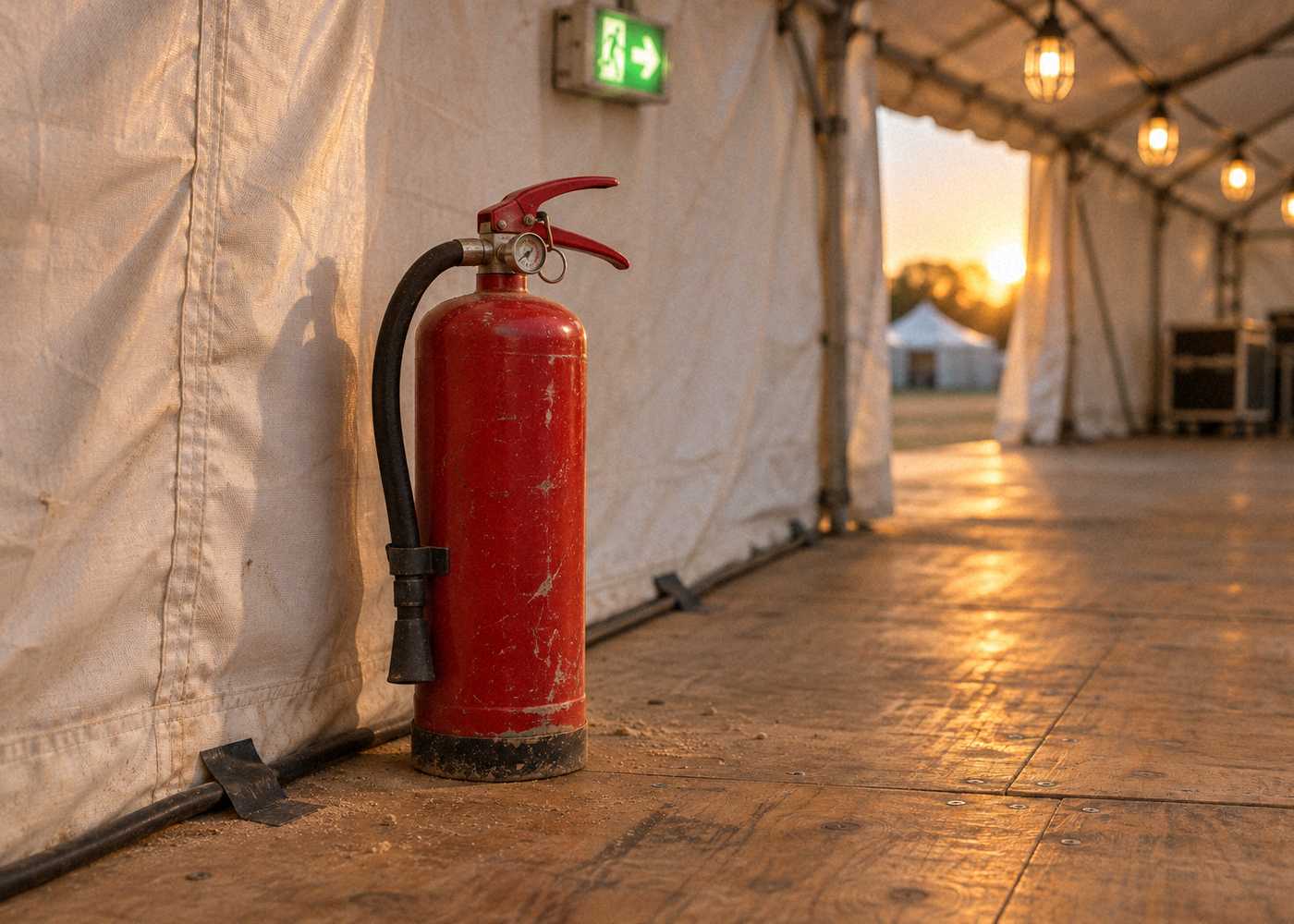
Tent fire safety for an Abu Dhabi winter event runs in two
separate stages: documents approved before the tent goes up, then a physical
inspection once it is fully built. This checklist is for organisers, venue
managers and contractors preparing a commercial event tent, and it works best
if you start it before the layout is final.
The research was checked on 3 November 2026. The main
sources are the Abu Dhabi Public Health Centre (ADPHC) Code of Practice 43 for
Temporary Structures (CoP43, version 4.1, effective 27 February 2026, with
editorial changes only) and the Abu Dhabi Civil Defence Authority (ADCDA)
guideline ADG 45/2024. The organiser handbook of ADNEC (Abu Dhabi National
Exhibitions Company) appears as an example of venue conditions, not as
emirate-wide law.
Each item carries a label: Organiser, Venue or Contractor.
These are recommended working assignments so nothing falls between teams. They
do not reassign anyone's statutory duties. Items marked Priority are the ones
most often missed.
This is the paperwork stage. Nothing here proves the tent is
safe, but a gap here can stop the build.
- Organiser: submit early. CoP43 requires commercial-tent
submissions at least 10 working days before erection. That is a planning
milestone, not a promised approval time, so build in slack.
- Organiser: secure the event permit and supporting
approvals. ADG 45/2024 requires an event permit from the Department of Culture
and Tourism (DCT), structural plans approved by the Department of
Municipalities and Transport (DMT) and a fire-safety compliance certificate.
DCT applications go through TAMM, and a Civil Defence approval is not the same
thing as the event licence.
- Contractor: collect material certificates. ADG 45/2024
requires fire-performance certificates for tent construction materials and
internal decorative textiles. Flame-retardant fabric is not fireproof, and an
overseas certificate does not automatically satisfy ADCDA.
- Contractor: assemble supplier papers. Valid supplier
licensing, preventive-safety certification and an event equipment schedule are
all required under ADG 45/2024.
- Organiser: prepare the emergency plan. It must show the area,
assembly points, exits and entrances. A plan drawn after the layout changes
will not match what inspectors see, so match it to the approved drawings. For a
wider view, see our guide on building a complete fire safety plan.
- Venue: confirm site conditions in writing. At ADNEC, for
example, Civil Defence approval comes before construction, the
temporary-structure provider needs Abu Dhabi Municipality approval for outdoor
structures, and staking is banned in favour of ballast anchoring. Other venues
will have their own rules, so ask for them.
Published Abu Dhabi documents do not always agree. Do not
quietly pick the figure you prefer.
|
Item |
CoP43 |
ADG 45/2024 (paraphrased) |
|
Exit travel distance |
30m inside the tent |
45m escape travel |
|
Extinguisher travel distance |
15m |
23m |
Ask ADCDA to confirm, in writing, which provision applies to
your particular event. Do this before equipment is placed, because moving an
extinguisher or exit later can mean moving everything around it.
This is the first physical stage, and it is where changes to
the approved layout become a Priority problem. If a stage, bar or seating block
moves, go back to ADCDA before it moves, not after.
- Venue: check the 6m separation. CoP43 counts guy ropes in
this distance, and it applies to plot lines, buildings, other tents, parked
vehicles and combustion engines. Measure from the ropes, not just the fabric.
- Priority, Venue: keep emergency access clear. ADG 45/2024
requires a Civil Defence vehicle roadway at least 6m wide covering event
locations and assembly points. Parked delivery trucks and crowd barriers are
the usual culprits.
- Venue: check hydrant access. Every part of the tent must
be within 100m of a hydrant under CoP43, with 3m clear around hydrants, firefighting
inlets and neighbouring fire-exit stairs.
- Contractor: count and measure the exits. CoP43 requires at
least two exits, each 2m wide or more. Do not work out permitted occupancy from
the number of exits alone. The organiser should obtain the accepted occupancy
for the actual use and layout.
- Contractor: keep escape doors open and signed. ADG 45/2024
requires escape signs above escape doors, and the doors must remain open. Test
every one by hand.
- Contractor: keep 1m between fabric and contents. CoP43
requires this gap, so check behind drapes, stacked chairs and storage.
Walk the tent with the equipment schedule in hand and tick
off each item you can see.
- Contractor: install fire detectors. ADG 45/2024 requires
them and prefers battery-operated units from an Authority-approved company.
That preference does not mean a standalone domestic alarm suits every event's
approved design.
- Priority, Contractor: fit smoke detectors on return-air AC
units. CoP43 requires this. Because winter events still run air conditioning,
these units are easy to overlook.
- Contractor: place 2.5kg ABC powder extinguishers. CoP43
sets them within 15m travel, but see the table above for the conflicting ADG
figure. Our note on types of fire extinguishers in the UAE explains what the labels mean.
- Contractor: add CO2 extinguishers at power sources. CoP43
requires two 2.5kg CO2 units near each generator or AC set.
- Priority, Contractor: prove battery standby on exit signs.
CoP43 requires illuminated exit signs with battery standby power, and ADG
45/2024 requires emergency lighting inside the tent. As a practical check, ask
the contractor to show the signs staying lit when the mains supply is isolated.
- Contractor: secure the wiring. CoP43 requires wiring fixed
and routed away from public paths. Loose cable across a walkway is both a trip
and a fire risk.
Cooking is where good intentions in an application can
mislead people.
- Organiser: confirm the cooking arrangement with ADCDA. ADG
45/2024 permits outdoor event cooking with electrical equipment and no gas
cylinders, and it prohibits cooking equipment inside tents. Mentioning an LPG
installation or open-flame device in an application is not permission to use
it.
- Venue: set aside an outdoor cooking area. It must sit
within the separation and access rules above, so decide its position at layout
stage.
- Contractor: place trolley extinguishers by food courts.
ADG 45/2024 specifies 25kg trolley extinguishers beside event food courts.
Document approval does not replace the physical inspection.
CoP43 schedules the inspection after erection, at least two days before the
event.
- Priority, Contractor: complete erection before the
inspection. A half-built tent, or one waiting on its detectors, wastes the
slot. ADNEC also expects the supplier to inspect a tent thoroughly after
erection and before use, so do your own walk-through first.
- Organiser: assign trained personnel. CoP43 requires
trained organiser personnel to manage agreed occupancy and emergencies. ADG
45/2024 also asks security staff to understand evacuation and show evidence of
approved extinguisher and first-aid training.
- Organiser: brief everyone. Staff, exhibitors and
contractors should know the alarm, the exits and the assembly points. A short
drill helps, as explained in our piece on regular fire drills.
- Venue: clear combustible waste. CoP43 requires clearance
inside the tent and within a 10m perimeter outside it. Smoking is prohibited
inside.
- Organiser: check before each event day. Confirm exits are
clear, firefighting equipment is in place and routes are open. ADNEC makes this
an organiser task, and it is a sensible habit anywhere.
The sources reviewed give no set re-inspection process.
Record every defect, name an owner from the three labels above, correct it, and
ask ADCDA how the re-inspection is arranged. Do not assume a date.
Treat them as part of the electrical installation. Show them
in your submission and get the ADCDA answer for your event, because the sources
reviewed give no Abu Dhabi-specific ruling.
The sources reviewed set no inspection interval for event
tents. Ask ADCDA and your approved supplier what applies, and record the answer
in your equipment schedule.
Website and SEO By Poland Web Designer
Guard Master © Copyrights 2020 - 2026. All rights reserved.
