You are fitting out a leased office or refurbishing an
occupied building, and three quotations have arrived with three different ideas
of where the batteries should live. Choosing between them is easier once you
separate the engineering from the pricing.
Here is the short verdict on central battery vs
self-contained emergency lighting. For a small leased office with no existing
central supply, price self-contained equipment first, as long as the approved
design permits it. For a multi-floor property that already has a central
system, compare keeping or upgrading it against a monitored self-contained
redesign. Neither answer is automatic, because occupancy, the approved design
and Dubai Civil Defence (DCD) requirements control the specification.
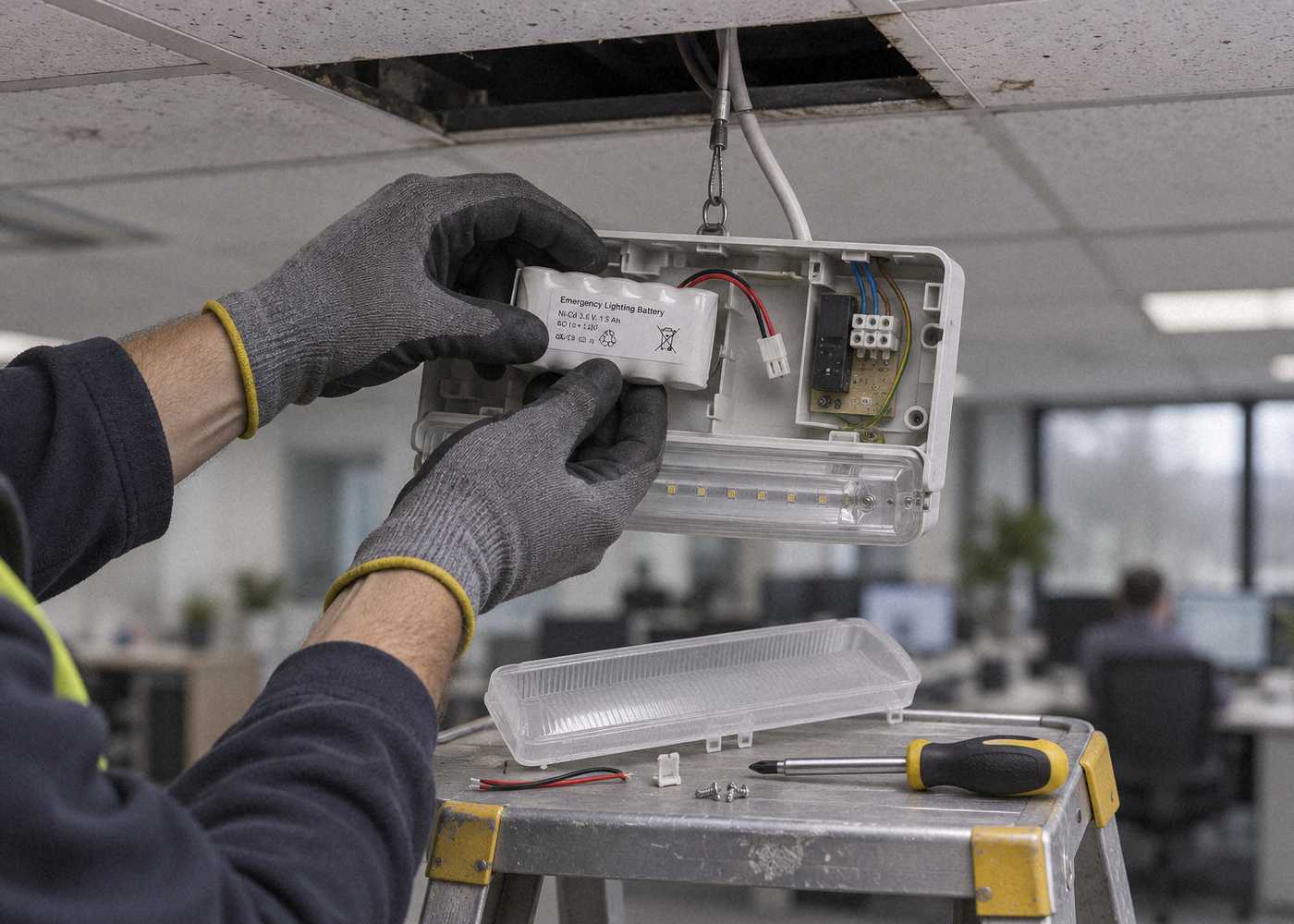
A self-contained luminaire has its own battery, normally
charged from the mains lighting circuit. When the normal supply fails, it
lights itself.
A central battery system feeds luminaires that have no
battery of their own. The shared supply holds the batteries, charging,
changeover equipment and alarms. Large buildings can also use several smaller
supplies, one per floor or fire protection section, instead of one
building-wide installation.
People often mix these up. "Self-contained" only
says where the battery sits. "Standalone", "self-test" and
"centrally monitored" describe how fittings are tested and reported.
Both architectures can use centrally monitored luminaires,
automatic testing and digital records. So a self-contained fitting can report
to a central dashboard, and a central battery system does not automatically
give you per-luminaire monitoring. Check the features in each quotation, not
the name of the system.
A basic fitting's green charging light shows only that the
charging circuit has voltage. It does not prove the battery can last the
required duration.
|
Factor |
Central battery |
Self-contained |
|
Existing infrastructure |
Strong case if a usable supply and wiring already exist |
Little to reuse, but little to depend on |
|
Cabling and ceiling access |
Distribution cables need fire protection as local rules and
risk assessment require |
Mains circuits only, subject to the approved design |
|
Battery replacement access |
A few banks in one room, but the room needs suitable
conditions |
Packs spread across every fitting, so ceiling access matters |
|
Testing labour |
The duration test needs full-load conditions, so testing other
luminaires does not replace it |
Automatic tests help, but someone still checks indicators and
keeps records without central reporting |
|
Failure scope |
A shared supply fault can affect many fittings |
A battery fault usually affects one fitting, though shared
circuits can widen it |
|
Environment |
Battery room temperature matters |
Ceiling and fitting temperature matter |
|
Upgrade disruption |
Reusing cables needs compatibility checks |
Work reaches every fitting position in occupied areas |
Neither option is maintenance-free. Central battery
maintenance does not remove the need to maintain luminaires and distribution,
and automatic testing does not repair anything it finds.
Battery design life, warranty, replacement interval and
measured remaining capacity are four different things. Manufacturers usually
state a battery life only under set conditions, and temperature is one of the
main ones. Heat shortens battery life, so a hot ceiling void or plant room
matters.
Ask the supplier what temperature its life figure assumes,
and compare that with where the equipment will actually sit. Also confirm the
duration setting, since light output can change with it.
In Dubai, building owners must keep fire and life safety
systems maintained, and changes to them need approval from Dubai Civil Defence.
Installation and maintenance of these systems also fall to approved, licensed
specialists. A tenant therefore cannot swap the system independently of the
building's approved design.
Your consultant and a DCD approved contractor must confirm
what is allowed, and a monitoring dashboard is not proof of approval. Duration,
light levels and the test schedule must come from your designer, so this
article gives no figures for them. Our guide to fire
safety regulations in Dubai gives wider context. Rules change, so confirm
the current requirements with DCD before you commit.
The two examples here are invented modelling assumptions,
not completed projects or compliant designs. Example A is one leased office
with 12 self-contained fittings, accessible ceilings and no central supply
connection. Example B is one owner with six occupied floors, an existing
central system and 240 fittings.
Follow these steps for each permissible option:
1. Fix the analysis period. For Example A, run it once over
the full period and again over the remaining lease term.
2. Use the actual designed fitting count and the approved
duration, not the modelling numbers.
3. Enter every quoted cost once. If an annual maintenance
contract covers inspection or reporting, do not add it again.
4. Multiply the battery packs or banks replaced by the
quoted installed replacement cost. Add access separately only if the quote
excludes it.
5. Use real replacement years. As a hypothetical, changes in
years four and eight mean 24 pack replacements for 12 fittings and 480 for 240.
These are calculated actions, not predicted failures or mandatory intervals.
6. Add the initial cost, the annual costs across the period,
and the scheduled replacement and disruption costs. Then subtract any residual
value you can evidence.
The result is an undiscounted total, so label it that way.
|
Line item |
Option 1 (AED) |
Option 2 (AED) |
Option 3 (AED) |
|
Equipment and installation quotation |
|
|
|
|
Reusable infrastructure |
|
|
|
|
Design and approval-related quoted costs |
|
|
|
|
Commissioning |
|
|
|
|
Annual inspection and reporting labour |
|
|
|
|
AMC inclusions |
|
|
|
|
Monitoring charges, if any |
|
|
|
|
Energy |
|
|
|
|
Battery replacement events |
|
|
|
|
Access equipment |
|
|
|
|
Out-of-hours work |
|
|
|
|
Making good |
|
|
|
|
Disposal |
|
|
|
|
Contingency |
|
|
|
|
Residual value (deduct) |
|
|
|
|
Undiscounted total |
|
|
|
Leave project prices blank until you hold itemised AED
quotations. No universal Dubai price or break-even point exists, so only your
own quotes can settle which option costs less.
- Small leased office, no central supply: price
self-contained equipment first, with monitoring if you want records without
walking the floor. Confirm the approved design allows it.
- Multi-floor building with a central system: price renewal
against an approved monitored self-contained redesign, including access across
occupied floors.
- Ageing central battery bank: judge it by condition and
duration-test results, not age alone, since batteries in both architectures
lose capacity.
- Reusing cables or luminaires: do not assume it works.
Matching voltage is not proof of compatibility, and AC/AC and AC/DC supplies
need matching luminaires.
Whichever you pick, plan how compliant emergency cover is
kept during works, testing and recharge. A fire-resistant cable guide and our note on annual maintenance contracts help when you check what each quote includes.
Website and SEO By Poland Web Designer
Guard Master © Copyrights 2020 - 2026. All rights reserved.
