How do you charge an e-scooter at home without creating a
fire risk? In short: confirm your building allows it, charge on a hard surface
away from anything that burns and away from your exit, use only the charger
approved for your scooter, and stay awake and present while it charges. This
guide walks through those steps in order, then covers what to do if something
goes wrong.
You will need your scooter's manual, the charger that came
with it, and a few minutes to check your building's rules.
Start with permission, not with the socket. A 2023 Khaleej
Times report found that some Dubai residential buildings did not allow
e-scooters inside apartments, and an Al Barsha administrator said the
restriction came from building management. That was one building's policy, not
a Dubai-wide ban, and it cannot tell you what your building says today.
So ask your landlord, property manager or community
management for the current rule on bringing in, storing and charging scooters.
Get the answer in writing if you can. A building rule is separate from Civil
Defence advice: management can be stricter than the safety guidance, but it
cannot make an unsafe setup acceptable.
Sharjah Civil Defence published battery safety guidance
dated 27 April 2026. It names damaged cells, incorrect chargers and poor
charging habits as triggers for thermal runaway, which is a rapid, self-feeding
overheating that leads to fire and toxic smoke. These are awareness pages from
one emirate's authority, not a nationwide law, but they are the most local
starting point available, and the advice matches what fire services elsewhere
say.
Manufacturer instructions come next, because limits differ
by model. Xiaomi says its Electric Scooter 4 Pro Max will not charge below 0°C
or above 40°C ambient temperature. Segway lists 0 to 45°C for its Ninebot F2
series, with charging times of 6.5 hours for one model and 8 hours for two
others. Do not borrow one scooter's numbers for another. Read your own manual.
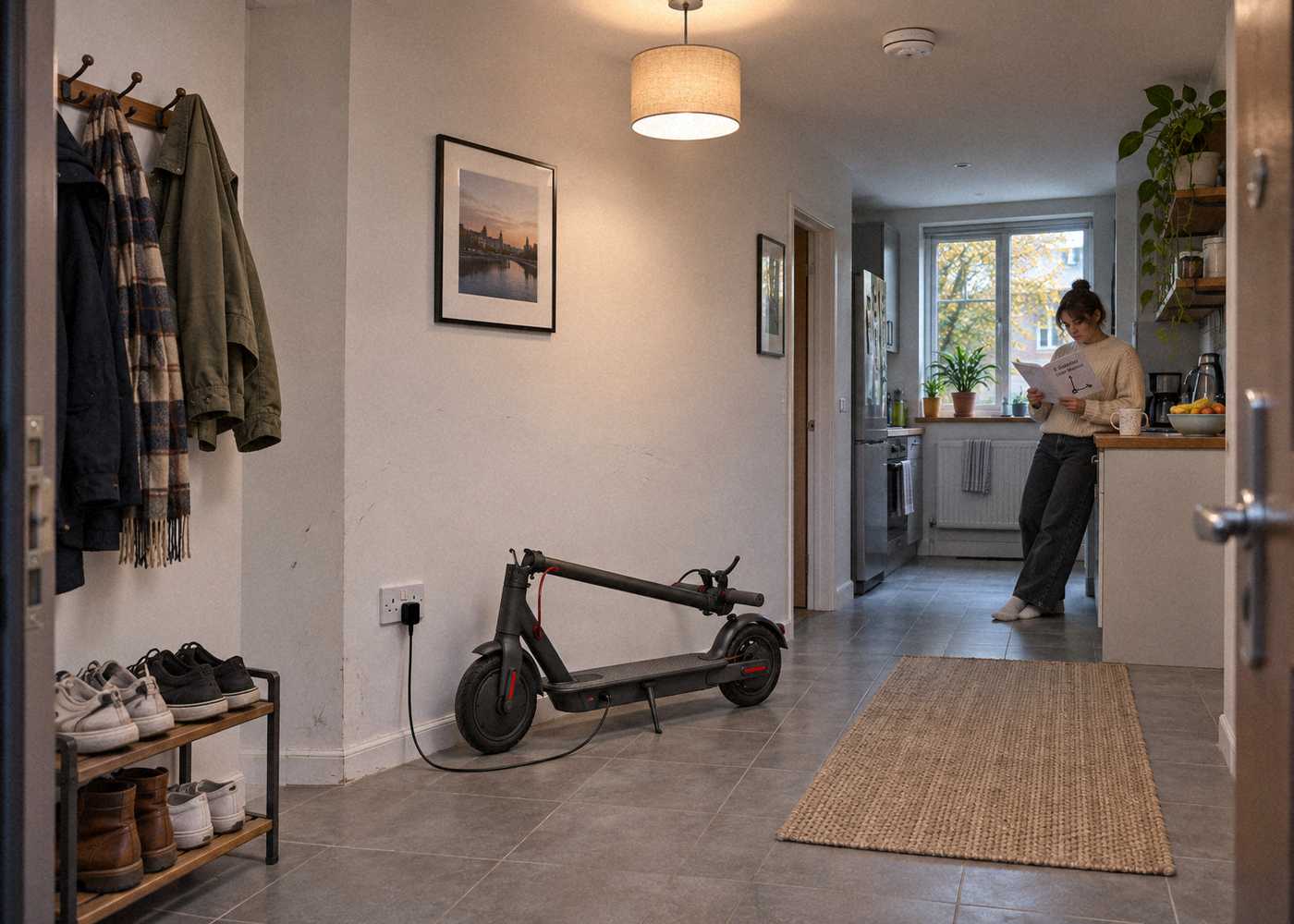
Charge on a hard, non-combustible surface such as tile or
concrete. Keep the scooter and charger away from beds, sofas, curtains and
other things that burn, and never in an escape route. A fire in a hallway or by
the front door can trap everyone inside.
Two spots people assume are fine are not:
- Balconies. Sharjah Civil Defence's separate balcony
guidance, also dated 27 April 2026, advises against both charging and storing
e-scooters or lithium-ion batteries there.
- Communal areas. UK government guidance advises against
charging in shared areas of multi-occupied buildings or anywhere a fire could
stop people leaving.
A garage can work, but check it first. Look for heat, damp,
stacked boxes and the distance to the exit. Never cover a battery or charger.
Imagine a tenant in a one-bedroom apartment whose building
allows scooters. The tiled kitchen floor, away from the cabinets and well clear
of the front door, beats the carpeted bedroom or the sofa corner. A working
smoke alarm nearby helps too.
Now imagine a villa owner with a garage. The garage is
crowded with boxes and gets very hot, and the charger sits next to the door to
the house. Clearing the boxes, finding a spot away from the exit and checking
the manual's temperature limit comes first. If the garage cannot meet those
conditions, it is not the answer.
If your building bans charging and you have no safe tiled
spot or clear garage, do not charge on the balcony or in a corridor as a
workaround. Ask management whether a designated area exists, or charge the
scooter at a location that permits it. If neither is possible, this scooter may
not suit your home.
Use the charger supplied with the scooter, or a replacement
that the manufacturer has confirmed for that device. The US Consumer Product
Safety Commission warns that a plug can fit while the charger is still
electrically wrong, and that a claim like "works with the whole
brand" proves nothing about your model. Wrong voltage or current can overheat
a battery, according to Fire and Rescue NSW.
So if your plug fits, that does not make it fine. Sharjah
Civil Defence also calls for certified chargers and advises against adapters
and extension leads, so plug straight into a wall socket.
Keep the charging contacts clean and dry. Norway's civil
protection directorate notes that dirt and moisture can cause short circuits
and heat. If your scooter got wet in the rain, let it dry and follow the manual
rather than forcing a charge.
The guidance above does not treat a built-in battery
management system, automatic cutoff, smart plug or timer as permission to leave
a scooter charging while you sleep. The US Consumer Product Safety Commission
advises being present while charging and never charging while sleeping, even
with the right charger. That is the core of e-scooter overnight charging
advice: charge in the evening while you are awake and nearby.
Unplug the charger from the scooter once charging ends.
After a ride, let the battery cool first and follow your manual, since no
universal cooling time exists. If you rarely ride, follow the manufacturer's
advice on how often to charge.
Some warmth during use or charging is normal. Extreme heat
is not. Do not touch the battery to test it. Watch for these instead:
- Swelling, bulging, a misshapen case, lumps, leaks or
cracks
- Hissing or cracking sounds, or a strong chemical smell
- A battery that will not fully charge, or charges for
unusually long
A battery that has been dropped, crushed, soaked or hit in a
crash should not be used or charged, because it can ignite without warning,
even when it is not plugged in. Do not open it or try a repair yourself.
Contact the dealer or manufacturer.
Also keep an old or damaged battery out of household
rubbish. Large lithium-ion batteries can start fires during collection and
processing. Confirm with the dealer or local authority where your specific
battery can go.
If you can do it without approaching a battery that is
smoking, hissing or getting dangerously hot, switch the scooter off, unplug the
charger and call the manufacturer or retailer. Do not restart charging to see
whether it happens again. If you cannot stay safely at a distance, treat it as
an emergency.
Leave. Close the doors behind you, call 997 for Civil
Defence, and do not go back in. Tell responders the battery type and where it
is. Do not carry the scooter out through a corridor, lift or stairwell, do not
stop to unplug it, and do not try to fight the fire. The UAE Government also
advises against using lifts, collecting belongings or returning until police or
Civil Defence say the building is safe. Call 998 if someone needs an ambulance.
Run through a quick list: building rule confirmed, hard
surface, nothing flammable nearby, exit clear, correct charger plugged directly
in, and you are awake and in the room. If every item holds, your setup is
sound.
For the wider picture, our guide to understanding fire safety regulations in Dubai explains the rules, and fire safety solutions for residential and commercial spaces covers alarms and
planning.
Website and SEO By Poland Web Designer
Guard Master © Copyrights 2020 - 2026. All rights reserved.
