Picture a fire alarm going off in a six-story office tower
at 2 a.m. The security guard sees one red light on the panel that says
"Zone 3." Zone 3 covers half the third floor and a chunk of the
fourth. Now he has to walk every corridor with a torch, sniffing the air,
trying to find smoke before the fire department arrives. That five-minute
search could be the whole fire.
This is the everyday difference between two kinds of fire
alarm systems. One tells you a fire started somewhere in a general area. The
other tells you which detector, in which room, on which floor, picked up the
smoke. For anyone running a building in the UAE, the choice between them shapes
how fast a problem gets handled, how much money you lose, and whether you stay
on the right side of Civil Defence rules.
A conventional fire alarm system splits a building into
zones. Each zone is a group of detectors and call points wired together on one
circuit. When any device in that zone trips, the panel lights up the zone, but
it cannot tell you which device did it. If you have 20 detectors in a zone, you
have 20 places to check.
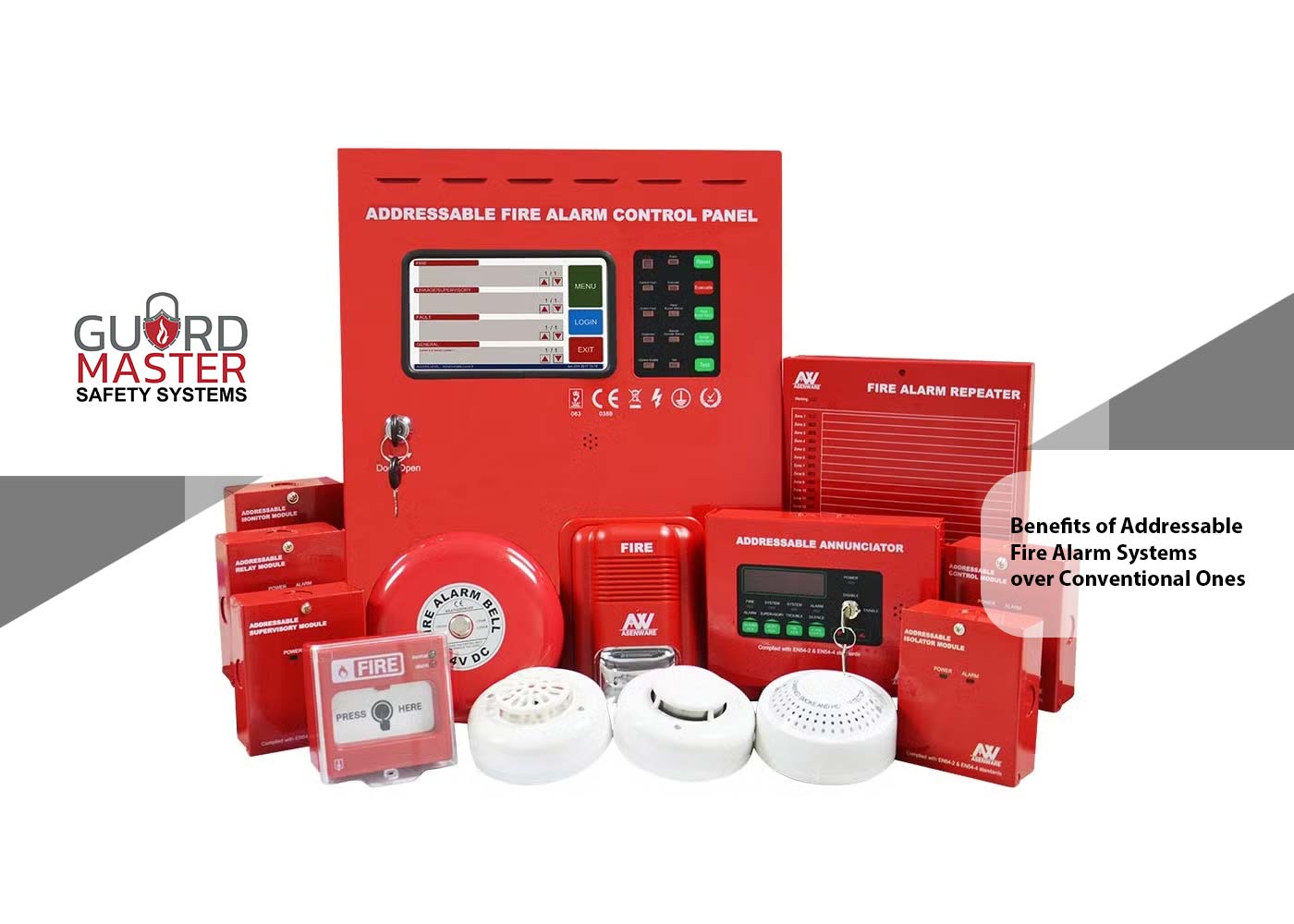
An addressable system works differently. Every detector,
call point, and module on the loop has its own unique address, like a phone
number. When a detector senses smoke, the panel shows the exact device, the
floor, the room, and often a written description such as "Storeroom B,
Level 4." The panel knows the difference between a real alarm, a faulty
sensor, a low battery, and a device someone unplugged.
For small buildings with simple layouts, a conventional
system can do the job. For anything bigger or busier, the limits become hard to
ignore.
The Abu Dhabi Civil Defence Authority puts the case plainly.
"The primary goal of Hassantuk is to achieve a response faster than the
danger. One second can make a difference in saving lives." That same
principle applies to the alarm system inside your building. The faster your
team finds the source, the smaller the fire stays.
With an addressable system, the panel hands you the location
on a screen. Security staff walk straight to the door. Civil Defence crews
arriving on site can be pointed to the exact floor and room without anyone
guessing. In a large warehouse, factory, or hotel, that saves real minutes. In
a multi-tenant tower, it also keeps you from evacuating the entire building
when the issue is one burnt toaster on the seventh floor.
False alarms cost real money. A factory that shuts
production for an hour, a mall that empties its shops during peak trading, a
hotel that wakes 200 guests at 3 a.m. for a faulty detector. These events
damage trust and revenue, and they make staff slow to react the next time the
bell rings.
Addressable systems cut false alarms in two ways. Each
detector reports its own status, so the panel can flag a dirty or failing
sensor before it triggers a false trip. Many systems also use what is called a
pre-alarm stage, where a detector that picks up small amounts of smoke alerts
the control room first, giving someone a chance to check before the full
evacuation alarm sounds. A conventional panel cannot do this. It either alarms
or it does not.
UAE rules have moved firmly toward connected, intelligent
fire safety. Installation of Dubai Civil Defence Hassantuk Commercial in all
public and private buildings and establishments in Dubai is a mandatory
requirement laid down by Law No. 24 of 2012, which lets Dubai Civil Defence
monitor buildings in real time for life and safety alarms. The Hassantuk system
must be installed after the building permit is issued but before the completion
certificate and occupancy.
Hassantuk works by linking your building's fire panel
directly to the Civil Defence command centre. Each detector is connected to the
Hassantuk Signal Receiving Center via Etisalat's IoT solution to enable fully
automatic real-time alerts to be sent to the centre whenever any detector is
triggered, and if the alert is confirmed, it is forwarded to the Civil Defence
dashboard with accurate information about the location and the affected sensor.
That kind of detailed reporting is far easier to build on
top of an addressable panel. A conventional system can be retrofitted, but the
data it sends is limited to zones, not devices. As Civil Defence keeps pushing
for richer real-time data, addressable becomes the practical choice for new
builds and major upgrades.
The first quote you get for an addressable system will look
higher than for a conventional one. The hardware costs more, and the panel is
more advanced. That is the sticker price. The long-term picture changes things.
A conventional system requires a technician to walk every
detector and test it manually. They climb ladders, swap batteries on guesswork,
and replace devices that may still be fine. An addressable panel logs the
health of every device. The maintenance team gets a printout showing which
detectors need cleaning, which need replacing, and which are sending faults.
Service visits get shorter. Spare parts get ordered for the right reasons. Over
a ten-year cycle, the labour savings often beat the higher install cost.
There is also the cost you do not see until something goes
wrong. A civil defence representative explained that globally it takes six
minutes on average for firefighters to arrive, but the danger of the smoke is
at its highest in the first three minutes. A faster, more accurate alarm
shrinks the damage that happens during those first minutes. The insurance bill,
the rebuild, the lost business. Those numbers dwarf the price difference
between the two panel types.
Modern buildings have rooftop gardens, basement parking with
EV chargers, data rooms, kitchens, and chemical stores. Each of these spaces
needs different detection settings. A kitchen needs heat detection that ignores
cooking smoke. A car park needs sensors that can spot a lithium battery fire. A
data room needs very early smoke detection that triggers before flames appear.
Addressable systems let you set rules at the device level.
Detector 47 in the kitchen ignores small heat changes. Detector 112 in the data
room runs on high sensitivity. Detector 88 in the car park talks to the
ventilation system to clear smoke. Conventional panels treat every detector in
a zone the same way, which means you compromise on settings to keep the system
stable.
The real question is not which system is better in theory.
It is which one matches the building you actually run. For a small warehouse
with a simple layout and modest occupancy, conventional may still serve. For
everything else, especially in the UAE where Civil Defence integration is now
the standard, the device-level visibility of an addressable system pays you
back in speed, fewer false alarms, lower maintenance bills, and a building that
talks clearly when it needs help. The fire does not wait while someone walks
the corridor with a torch. Your alarm system should not, either.
Website and SEO By Poland Web Designer
Guard Master © Copyrights 2020 - . All rights reserved.
